
If you are weighing epoxy or polyaspartic coatings against vinyl plank for a Chicagoland basement, the right answer depends on your basement’s condition more than which material looks best in a showroom. A seamless, abrasion-resistant coating system suits homeowners who want a durable, easy-to-clean surface, while vinyl plank appeals to those who want a wood-look finish and potentially more comfort underfoot, depending on the product and underlayment.
Neither option fixes an underlying water problem on its own. Before choosing a material, it helps to understand what is happening beneath your basement slab, how the two approaches differ in what they require, and what a complete, properly prepared project actually involves.
A1 Concrete Coatings serves homeowners throughout Elk Grove Village, North Shore communities such as Wilmette, Winnetka, Glencoe, and Deerfield, and Southern Wisconsin, and this guide focuses on the comparison questions that matter most for basements in this region.
Why Basement Moisture Should Drive the Decision First
A basement slab can look completely dry and still have an active moisture problem. According to Building Science Corporation’s guidance hosted by ENERGY STAR, moisture that passes through a slab may escape by evaporating off the surface, which is why a dry-looking floor is not proof that the concrete is moisture-free.
Installing an impermeable finish can change that natural drying behavior and allow moisture to accumulate beneath the surface instead of evaporating.
Building Science Corporation’s basement guidance also points out that warm, humid air can condense on a cooler basement slab during spring and summer.
That surface condensation is a different issue from moisture migrating up through the concrete or from an active leak, and each situation calls for a different solution rather than one flooring choice treated as a cure-all.
The practical takeaway: a visual inspection alone cannot tell you whether a basement floor is ready for a coating or for vinyl plank. Slab moisture conditions should be assessed using methods appropriate to the flooring system before an installation decision is made.
Epoxy, Polyaspartic, or Polyurea: Know What You Are Actually Comparing
“Epoxy” gets used as a catch-all term for basement coatings, but the chemistry behind a coating affects how it performs.
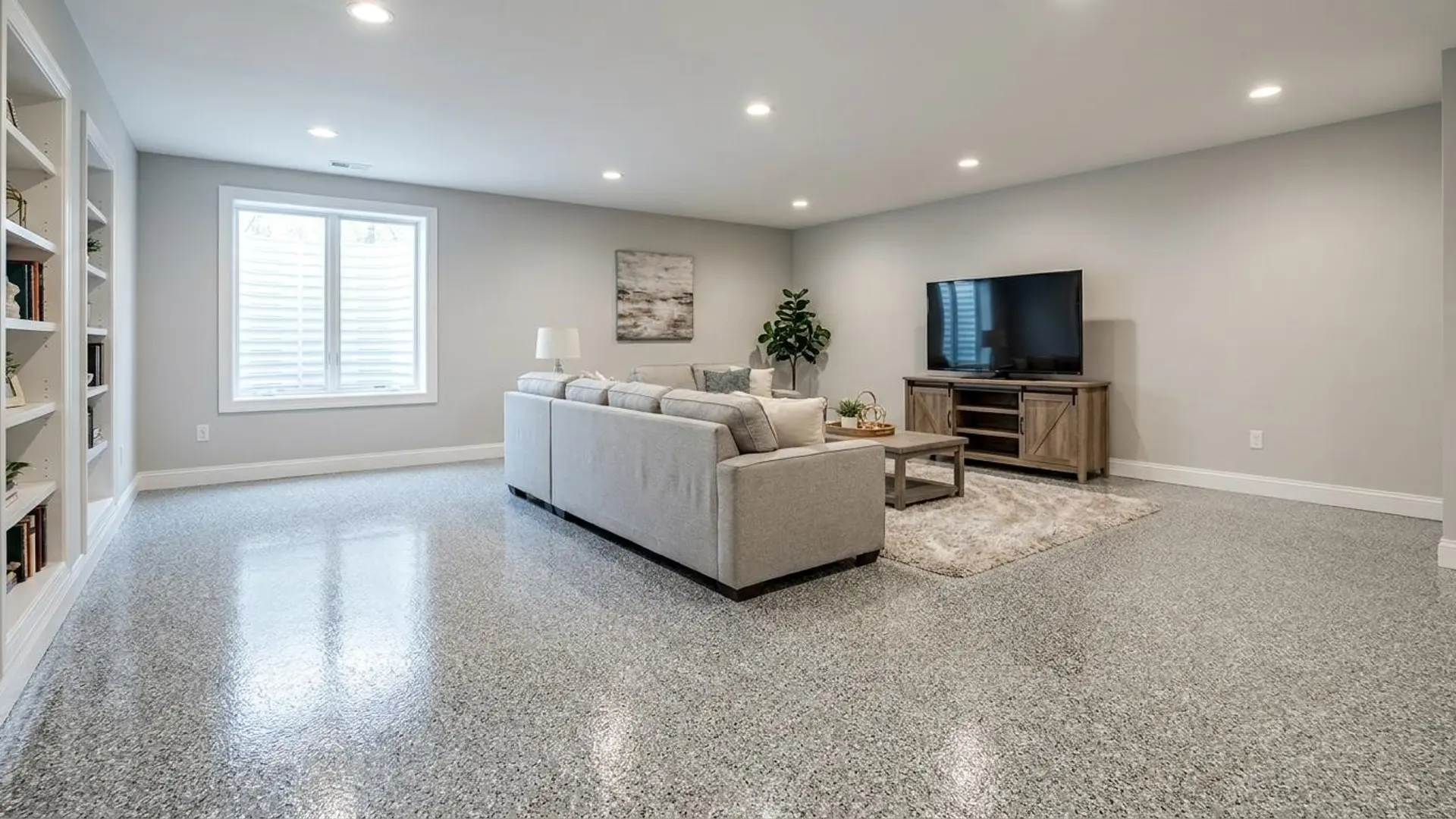
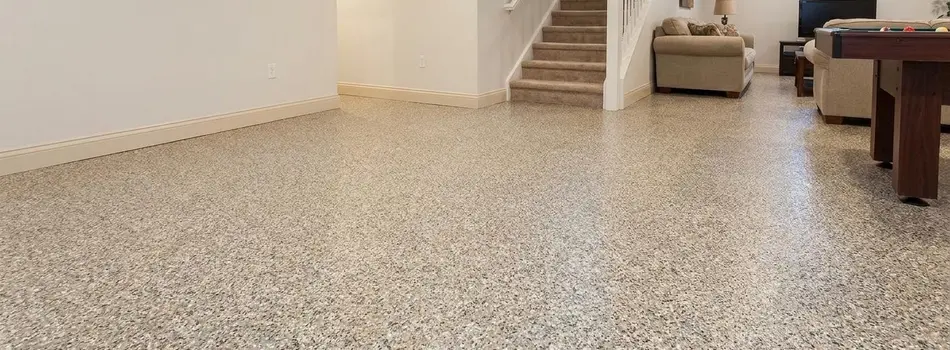
A1 Concrete Coatings offers Basement Coatings, Epoxy Flooring, Metallic Epoxy, and a 1-Day System. Its basement flooring options include polyurea/polyaspartic flake systems as well as metallic epoxy finishes.
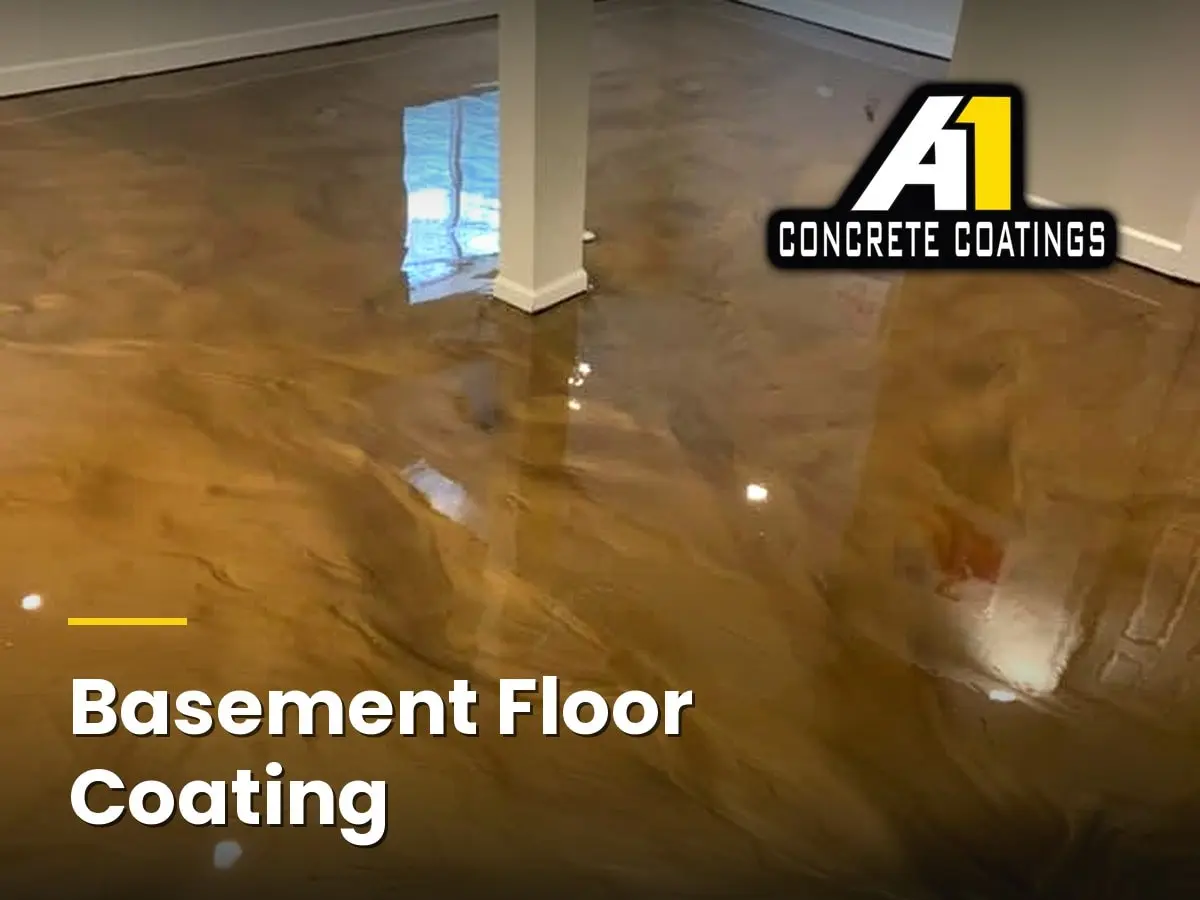
The company’s popular one-day flake system uses polyurea and polyaspartic technology, while metallic epoxy is available for homeowners who want a more decorative, marbled appearance.
That distinction matters because coating performance, cure behavior, and installation requirements vary by the specific resin system used, not just by the general category of “coating.”
As one industry example of what a seamless resin coating looks like in practice, manufacturer Sika describes its Sikafloor-264 epoxy product as seamless and abrasion-resistant, with smooth or textured finish options, while also requiring specific substrate-moisture evaluation and surface preparation before installation.
This is a general manufacturer example, not a description of A1’s specific product line, but it illustrates a point that applies across the coatings category: performance depends on the full assembly and substrate preparation, not on the word “epoxy” by itself.
Vinyl Plank in the Basement: Comfort With Conditions
Vinyl plank’s main appeal in a basement is comfort and appearance. It can reproduce the look of wood or stone, and manufacturers like Shaw offer compatible underlayment options that may improve comfort or sound control, depending on the product.
Not every installation needs extra underlayment, so the right combination depends on the specific plank and the room’s use.
The word “waterproof” on a vinyl product label describes the flooring’s resistance to water exposure, not whether the full floor assembly tolerates moisture moving up from underneath.
Shaw’s Invincible H2O installation instructions warn about trapped moisture and prohibit installation over concrete with a history of high moisture or hydrostatic conditions.
Those are product-specific installation rules rather than a universal limit on all vinyl plank, but they make an important point: waterproof vinyl is not automatically basement-ready vinyl.
Shaw’s vinyl installation guidance also notes that an appropriate substrate and expansion space are required, and that floating-floor installation still depends on evaluating slab flatness and perimeter details, not just laying planks down.
Any underlayment or moisture-vapor retarder should also be compatible with the flooring manufacturer’s instructions rather than added automatically.
Comparing the Full Project, Not Just the Material
A fair comparison looks at the complete installed project, not a plank-only retail price next to a coating quote.
Shaw’s guidance identifies removal of old flooring, furniture handling, subfloor preparation, and underlayment as potential parts of a vinyl installation. Additional moisture-control materials may also be necessary depending on the selected product and slab conditions.
A coating system has its own scope considerations, including surface preparation, crack repairs, moisture mitigation when specified, and curing time.
Comparing two options fairly means lining up what each quote actually includes, not just the price per square foot of material.
Timing is another area where it helps to separate installation milestones.
For resin coatings, installation completion, foot-traffic readiness, and full cure can occur at different times. As one illustration, Sika lists its Sikafloor-264 product reaching foot-traffic readiness in roughly 12 hours and full cure in about seven days at 68°F.
Those figures describe that specific product and should not be assumed for A1’s coating systems.
Vinyl plank has different timing considerations. A floating, click-lock floor does not require resin curing, although the room still needs to meet the manufacturer’s installation and return-to-use requirements. Glue-down vinyl may have additional adhesive-setting restrictions.
The broader lesson applies to any basement flooring decision: ask specifically when the room can be walked on, when furniture can go back, and whether any curing or adhesive-setting restrictions apply.
Before approving a project:
- Confirm whether slab moisture has been assessed before comparing materials.
- Ask what resin or vinyl product system is actually being proposed, not just the category name.
- Request a full scope breakdown, including preparation, underlayment, or moisture-control materials, before comparing prices.
- Clarify foot-traffic timing, furniture placement, and any applicable curing or adhesive-setting requirements for the specific product quoted.
A1 Concrete Coatings advertises installation and product warranties for its coating systems. Ask for the written warranty terms that apply to the specific coating and installation being proposed.
For more on the coating side of this comparison, see A1’s basement floor coating systems or review basement coating options for Northern Illinois homes.

Get a Basement Assessment From A1 Concrete Coatings
If you are deciding between a basement coating and another flooring option, start with an accurate assessment of your slab conditions.
A1 Concrete Coatings works with homeowners across Elk Grove Village, North Shore communities including Wilmette, Winnetka, Glencoe, and Deerfield, and Southern Wisconsin to evaluate basement floors and recommend coating systems suited to the space.
Call (866) 212-6284 to schedule a basement coating assessment and request a detailed proposal you can compare against other flooring options.

Under the direction of founder Luis Contreras, A1 Concrete Coatings provides various types of concrete coatings, including flake floors, solid concrete dyes, polished concrete floors, metallic epoxy floors, quartz epoxy floors, and urethane cement-coated floors. Louis and Angie Contreras built A1 Concrete Coatings from the ground up. Louis runs every job: handling estimates, leading installs, and ensuring each floor meets the standards the company was built on.